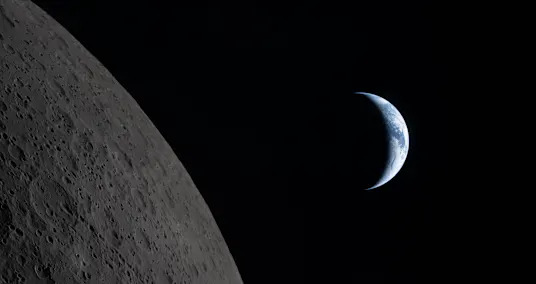
NASA has released the first images taken by the Artemis II crew during their historic trip around the far side of the moon.
The four astronauts — NASA commander Reid Wiseman, pilot Victor Glover, mission specialist Christina Koch and Canadian Space Agency mission specialist Jeremy Hansen — spent Monday’s seven-hour lunar flyby taking photos and making observations from the Orion spacecraft, which they named Integrity.
Among the stunning new images uploaded by NASA on Tuesday was a photo of “Earthset,” which was captured through the Orion capsule’s window at 6:41 p.m. ET, according to NASA.
"A muted blue Earth with bright white clouds sets behind the cratered lunar surface," the photo caption reads. "The dark portion of Earth is experiencing nighttime. On Earth’s day side, swirling clouds are visible over the Australia and Oceania region.”
Visible in the foreground is the moon, with the Ohm crater’s “terraced edges and a flat floor interrupted by central peaks,” per NASA’s description.

The crew also captured “Earthrise,” recreating the iconic photo taken during the Apollo 8 mission in 1968.

Also included in the new batch of images is a view of the solar eclipse that the crew experienced near the end of the flyby.

The astronauts donned eclipse viewers to protect their eyes during the nearly hour-long celestial event. But they still struggled to put into words what they were witnessing.

“Humans probably have not evolved to see what we're seeing," Glover told mission control. "It is truly hard to describe.”

Other photos captured close-up views of the lunar surface, including little-seen craters and basins from the vantage point of the crew, which at one point came within about 4,000 miles of the moon.
During Monday’s flyby, the Artemis II set a new record for the farthest distance from Earth traveled by humans — 252,756 miles, surpassing the previous mark set by Apollo 13 in 1970.


LATEST POSTS
- 1
 Federal judge upholds Hawaii's new climate change tax on cruise passengers
 - 2Gauging the Upsides and downsides of Visas: A Complete Aide
- 3New 'People We Meet on Vacation' trailer teases Poppy and Alex romance: Everything we know about the new Netflix movie
- 4Dinosaur collagen used to create one-of-a-kind handbag
- 5'Stranger Things' star debunks claims of 'unseen footage' from Season 5, Volume 2 as backlash intensifies ahead of the series finale




- The new queen of country music has no scandals and no gimmicks — and just broke a record set by Taylor Swift
- Iran steps up executions as experts warn state killing being used to suppress political dissent
- Geminid meteor shower, one of the year's most reliable, peaks this weekend
- Nine in 10 German industrial firms expect Iran war to hit business
- The Solution to Individual budget: Dominating Cash The board
- Instructions to Pick the Ideal Pre-assembled Home for Your Necessities
- Jury says Johnson & Johnson owes $40 million to 2 cancer patients who used talcum powders
- From record warming to rusting rivers, 2025 Arctic Report Card shows a region transforming faster than expected
- Nigeria police charge Joshua driver with dangerous driving over fatal crash