When you buy through links on our articles, Future and its syndication partners may earn a commission.

SpaceX will launch NASA's next exoplanet mission on Sunday morning (Jan. 11), and you can watch the action live.
A Falcon 9 rocket carrying about 40 payloads, including NASA's Pandora exoplanet satellite, is scheduled to lift off from California's Vandenberg Space Force Base during a 57-minute window that opens at 8:19 a.m. EST (1319 GMT and 5:19 a.m. local California time).
You can watch it live via SpaceX's website or X account; coverage will begin about 15 minutes before launch.
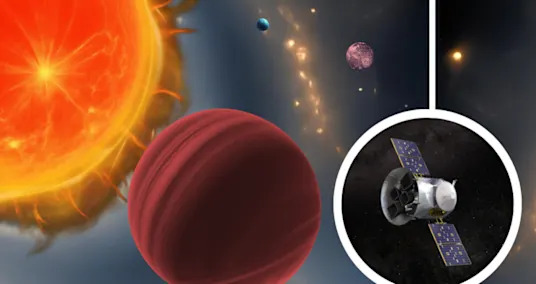
During its yearlong orbital mission, the 716-pound (325 kilograms) Pandora will study at least 20 known exoplanets using a 17-inch-wide (45 centimeters) telescope, which it will train on the worlds as they "transit," or cross the face of, their host stars from the satellite's perspective.
Such transits cause a small dip in the host star's brightness, which exoplanet hunters have used to great advantage: Most of the more than 6,000 alien planets we know of have been discovered via the "transit method."
Transits also allow astronomers to characterize known exoplanets, especially their atmospheres. Different elements and molecules absorb light at specific wavelengths, so studying the spectrum of starlight that has passed through an atmosphere can reveal a great deal about that atmosphere's composition.
However, such work is complicated by stellar complexity. Star surfaces are not uniform; they often feature patches of varying brightness, like the sunspots that speckle our own star. Pandora will help astronomers account for such complexity, if all goes to plan.
"Pandora aims to disentangle the star and planet spectra by monitoring the brightness of the exoplanet's host star in visible light while simultaneously collecting infrared data," NASA officials wrote in a mission description. "Together, these multiwavelength observations will provide constraints on the star's spot coverage to separate the star's spectrum from the planet's."

Pandora will focus on planets with atmospheres that are dominated by water or hydrogen, agency officials added.
The other three dozen or so satellites going up on the Twilight mission are a diverse group. Among them are 10 of Kepler Communications' Aether spacecraft and two of Capella Space's advanced new Acadia Earth-imaging radar satellites.
SpaceX is no stranger to rideshare missions like Twilight. To date, the company has launched 15 such flights in its Transporter series and four via a different program known as Bandwagon.
Twilight will mark the fifth liftoff for this particular Falcon 9's first stage. If all goes according to plan, the booster will land back at Vandenberg about 8.5 minutes after liftoff.
LATEST POSTS
- 1
 Eating Brie, Gouda, cheddar may lower dementia risk, new study says
 - 2World's oldest known tortoise still very much alive despite rumor to the contrary
- 3Iran's stolen futures: The arrested Iranians at risk of execution by the regime
- 4An Aide On Upgrading Your FICO rating
- 5A Gastronomic Experience in Healthy Enjoyments: A Survey of \Nutritious and Tasty\ Solid Cooking Recipe Book





- Machado ‘presented’ her Nobel Peace Prize medal to Trump
- Starship success, a private moon landing and more: The top 10 spaceflight stories of 2025
- This Flashy Old-School Design Trend From Italy Still Has A Place In Modern Kitchens
- Boats escort freed whale away from shallow waters off German coast
- Porsche May Kill the Electric Boxster Before It Ever Arrives
- The Force of Systems administration: Individual Examples of overcoming adversity
- 100 new alien worlds: Scientists find hidden haul in data from NASA exoplanet-hunting spacecraft
- The Most recent Microsoft Surface Genius PC: Ideal for Very good quality Planning and Gaming Needs
- Virtual National Science Foundation internships aren’t just a pandemic stopgap – they can open up opportunities for more STEM students